How to Get Customers and Advertise Your Business: A Tactical Guide
NovaEdge Editorial Team
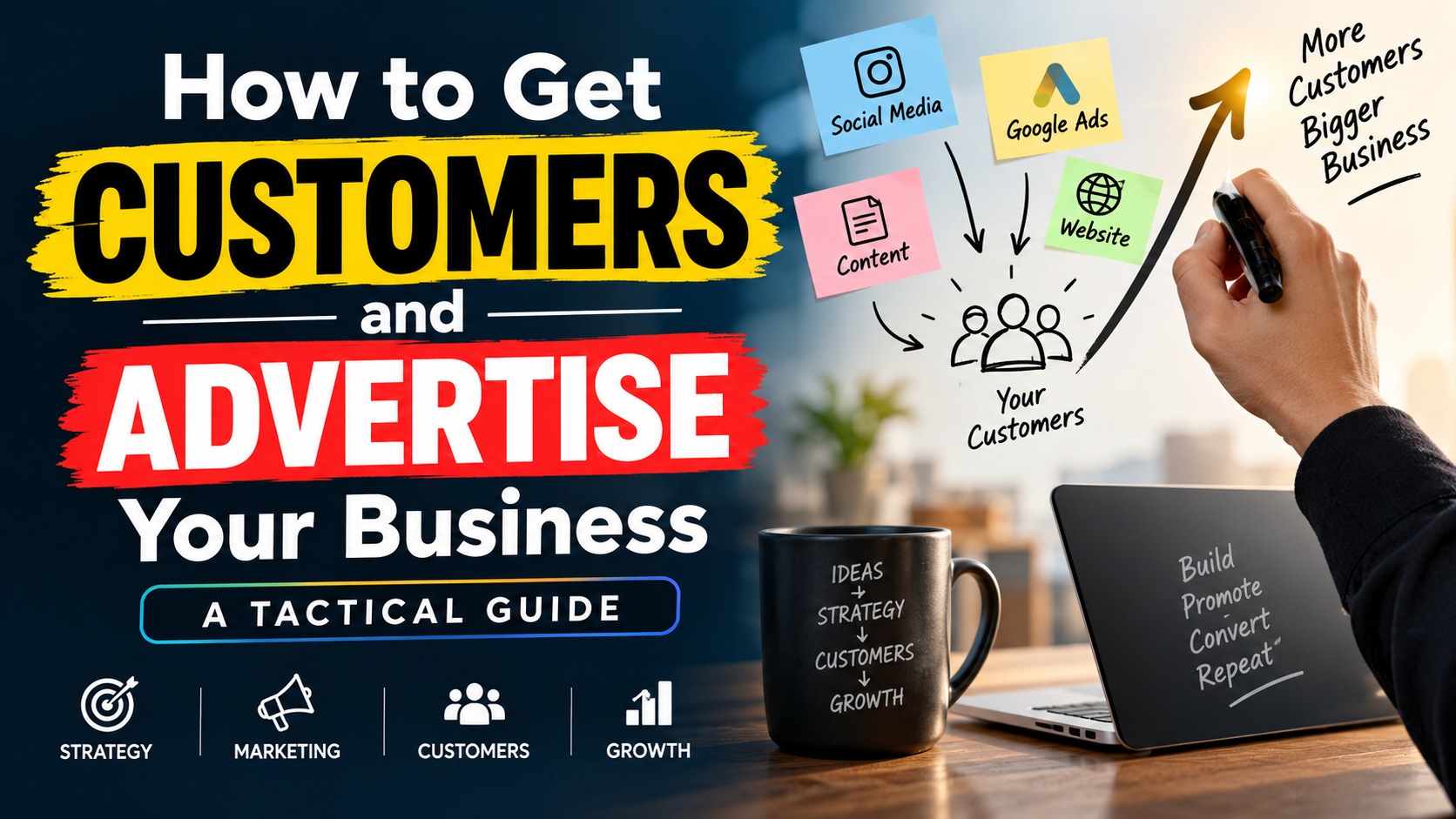
Acquiring customers is about intercepting the right people at the exact moment they experience a problem. Discover high-signal direct outreach, SEO backlink strategies, and product-led growth to scale your business.
Most advice surrounding customer acquisition and business advertising falls into a predictable trap of vague platitudes. Business owners are frequently told to build a brand, post consistently on social platforms, and run targeted advertising campaigns. While technically accurate, these statements lack the mechanical depth required to execute a successful growth strategy in a highly saturated market.
Acquiring customers is not about shouting the loudest; it is about intercepting the right people at the exact moment they experience a problem your business solves. Advertising is simply the mechanism used to scale that interception. This guide breaks down the precise, non-generic strategies required to identify, capture, and convert your ideal customers while ensuring every dollar spent on advertising yields a measurable return.
The Foundation: Aligning with Market Friction
Before spending capital on advertising or investing hours into outbound sales, you must verify that your core offer aligns with a real, painful market friction. Many businesses fail because they attempt to advertise a product that the market does not urgently need.
Instead of relying on superficial buyer personas that list ages and zip codes, conduct a friction audit. Identify the specific, frustrating bottlenecks your potential customers face daily. When your advertising messaging addresses this exact friction, your conversion rates increase dramatically because the prospect feels understood.
Positioning is the first step of acquisition. If you run a commercial landscaping company, advertising that you cut grass is generic and invites price comparison. Advertising that you ensure corporate properties pass municipal compliance inspections without requiring the property manager to lift a finger changes the value proposition entirely. You move from a commodity to a specialized problem solver. This subtle shift in positioning makes all subsequent advertising significantly cheaper and more effective.
Systemic Customer Acquisition Strategies
Customer acquisition should operate as a predictable system rather than a series of random promotional events. To build this system, you must balance short-term direct response tactics with long-term asset building.
Signal-Based Direct Outreach
Cold outreach has a poor reputation because it is typically executed as mass spam. The alternative is signal-based outreach. Rather than contacting a thousand random businesses, monitor specific trigger events that indicate a need for your service.
If you sell IT security software, do not send generic emails about your features. Instead, monitor public job boards for companies hiring their first compliance officer or track news about recent industry regulations. When you reach out, your message is hyper-contextual: you noticed their recent hire, you understand the compliance hurdle they are facing this quarter, and you have a framework to solve it. This approach requires more research per prospect, but the conversion rate from outreach to conversation is exponentially higher.
Engineering Product-Led Growth
The most cost-effective customer acquisition channel is a product or service that naturally acquires new users simply by being used. Look for ways to build visibility into the delivery of your work.
If you are a web developer, ensure a discrete credit link exists in the footer of the sites you build. If you provide a B2B service, structure your delivery so that it requires the client to invite their external vendors into your platform. If you run a consulting firm, publish your proprietary frameworks as open-source documents that other professionals will share. The goal is to design a mechanism where every successful client engagement automatically exposes your business to two more potential clients.
Ecosystem Partnerships
Strategic partnerships allow you to borrow trust from established entities. Identify businesses that share your exact target audience but solve a different problem. A commercial real estate broker and an office furniture supplier share the same client base but do not compete.
Establish formal referral agreements where you cross-pollinate your client lists. You can co-author industry reports, host joint educational webinars, or bundle your services into a single comprehensive package. This strategy bypassing the traditional advertising auction entirely and places your offer directly in front of warm, pre-qualified leads.
High-Signal Advertising Tactics
When you are ready to allocate a budget to advertising, you must shift your focus from vanity metrics, such as impressions and clicks, to unit economics. The only metrics that matter are your Customer Acquisition Cost and the Lifetime Value of the acquired customer.
Capturing High-Intent Search Queries
Interrupting people while they scroll through a social feed is fundamentally different from appearing exactly when someone actively searches for a solution. Search intent advertising, particularly through platforms like Google Ads, allows you to bid on specific phrases that indicate immediate commercial intent.
Do not bid on broad, generic terms. A keyword like "accounting software" is expensive and attracts users who are just browsing. A long-tail keyword like "cloud accounting software for freelance graphic designers" has lower search volume but indicates a user who knows exactly what they want and is ready to purchase. By dominating these highly specific, high-intent queries, you maximize your budget efficiency.
Educational Retargeting Sequences
Most initial website visitors will leave without making a purchase. The standard advertising response is to follow them around the internet with a banner ad offering a ten percent discount. This trains your audience to wait for price drops.
Instead, implement educational retargeting. When a user visits your pricing page and leaves, retarget them with a sequence of content that answers their primary objections. Show them a case study of a successful client, followed by a video demonstrating the implementation process, followed by an article explaining the total cost of ownership. You are using advertising dollars to mature the prospect, moving them from awareness to trust, rather than just begging for a transaction.
Lead Generation Through Micro-Tools
One of the most effective ways to advertise a complex B2B business is to build a free micro-tool. Instead of gating a standard PDF whitepaper behind an email form, build a calculator, an audit script, or an assessment tool.
If you sell supply chain logistics, build a free calculator that estimates warehouse storage waste. Users input their data and receive immediate, personalized value. In exchange, you collect highly qualified leads along with the exact data you need to customize your subsequent sales pitch. The tool itself becomes an advertising asset that people naturally share and link to.
The SEO Advantage: Stealing Market Share with Backlinks
While paid advertising provides immediate traction, organic search engine optimization builds compounding enterprise value. However, publishing well-written content is no longer sufficient to rank in competitive markets. Search engines rely heavily on domain authority to determine which sites deserve the top positions, and domain authority is driven primarily by your backlink profile.
Acquiring customers through SEO requires treating link building as a core marketing operation. A backlink is a hyperlink from an external website pointing to your domain. Search engines view these links as votes of confidence; a link from a highly trusted industry publication carries immense weight.
Competitor Link Gap Analysis
The most efficient way to build an SEO advertising strategy is to reverse-engineer the companies already dominating your target keywords. Using advanced backlink analysis tools, you can extract the entire link profile of your top three competitors.
The goal is to perform a gap analysis. You identify domains that link to multiple competitors but do not yet link to your website. If an industry blog has reviewed your competitors, they have demonstrated a willingness to link out within your niche. Reaching out to these specific publishers to introduce your superior product is a high-probability tactic. You are not guessing where to build links; you are systematically closing the authority gap between your business and the market leaders.
Anchor Text Distribution and Toxic Link Management
Building links requires precision. The clickable text of a hyperlink, known as anchor text, provides context to search engines. If every site linking to you uses the exact same keyword phrase, it triggers algorithmic penalties for unnatural manipulation. A healthy backlink profile requires a natural distribution of branded anchors, naked URLs, and generic phrases.
Simultaneously, you must actively monitor your domain for toxic links. Links from penalized domains, automated link farms, or irrelevant foreign websites can degrade your search visibility. Regular backlink audits allow you to identify these malicious links and disavow them through search engine webmaster tools, protecting your primary source of organic customer acquisition.
Digital Public Relations for Authority
Securing high-quality backlinks at scale requires digital public relations. Instead of begging for links, create linkable assets. Conduct original industry research, aggregate proprietary data, or publish definitive guides that journalists and bloggers naturally want to reference.
When you publish a comprehensive report on industry pricing trends, you can perform targeted outreach to journalists who cover your sector. When they write about the trends, they cite your report as the source, granting you a powerful, high-authority backlink. This tactic simultaneously builds your SEO authority and advertises your business as an industry thought leader.
Retention as the Ultimate Acquisition Tool
The most overlooked customer acquisition strategy is customer retention. The mathematics of business growth dictate that if your churn rate is high, you will eventually bankrupt the company trying to replace lost revenue.
Advertising is expensive. Acquiring a new customer can cost five to twenty times more than retaining an existing one. Furthermore, a highly satisfied customer base becomes your most powerful advertising channel. When your product delivery is exceptional, customers speak about it in private communities, on industry forums, and to their peers. This word-of-mouth advertising carries a level of trust that no paid campaign can replicate.
To weaponize retention, you must track time-to-value. How quickly does a new customer experience the core benefit of your business? If that timeline is long and confusing, they will abandon the product. If you engineer your onboarding process to deliver a quick, measurable win within the first forty-eight hours, you secure their loyalty.
Additionally, implement structured feedback loops. Do not wait for customers to complain; proactively measure their success and solicit their input on your product roadmap. When customers feel a sense of ownership over the direction of your business, they transition from passive consumers to active advocates.
Conclusion
Acquiring customers and advertising a business requires moving past generic advice and adopting a disciplined, systemic approach. It begins with precise market positioning, ensuring your offer solves a specific, painful problem. It requires shifting from mass, untargeted outreach to highly contextual, signal-based engagement.
When deploying advertising capital, prioritize high-intent search queries and educational retargeting over superficial metrics. Most importantly, build compounding organic visibility by treating SEO and backlink acquisition as a rigorous, data-driven operation. By executing these strategies deliberately, you transition from constantly chasing new leads to operating a predictable, scalable revenue engine.
Built & Curated by Amit Kumar Raikwar
Full-stack engineer & product designer shipping production software worldwide.
Frequently Asked Questions
Amit Kumar Raikwar
Full-stack engineer and product designer in Indore. I take software from an empty Figma file to a live product that takes payments, and I do the interface, the API, the database and the deploy myself.